
Have you ever sat down, determined to write your novel, only to watch the cursor blink on an empty Word document for hours?
Or perhaps you’ve muttered to yourself, “I want to write a book,” but have struggled with organizing your thoughts, let alone putting them into words.
You’re not alone. Fortunately, the internet has provided us with the Best Software That Writes Books, easing the book writing process for both new and seasoned authors.
Statistics show that 81% of Americans feel they have a book in them. In this article, we will navigate the vast ocean of book writing software, highlighting the ones that stand out in functionality, user-friendliness, and cost-effectiveness.
Whether you’re looking for the best app for writing a book or free writing software to kickstart your writing journey, we’ve got you covered.
The average book written by a first-time author takes over six years to write. But yours can take less time.
Let’s take the first steps to writing a book with this review of the best software that writes books, making penning your masterpiece a breeze.
The quest to find the best software that writes books can be daunting. With various book writing software options, it can take time to discern which suits your writing style, budget, and needs.
This guide will provide a thorough review of five top writing software: Atticus, Dabble, Novlr, Scrivener, and Microsoft Word.
Grammarly
Best for: Professional and novice writers aiming for grammatical precision.
Grammarly is a writing program that can help with grammar and spelling. Regarding the best software that writes books, Grammarly strides ahead confidently.
It’s more than just a spell-checking tool; it’s a comprehensive writing assistant ensuring your book is polished and virtually error-free.
Grammarly, your reliable writing companion, can assist you in crafting both fantasy novels and self-help guides..
Key Features:
- Real-time grammar correction.
- Context-specific suggestions for sentence improvement.
- Plagiarism detector to guarantee original content.
- Genre-specific writing style checks.
Pricing:
Grammarly offers both a free version and premium subscriptions. The premium version unlocks advanced features and insights, starting at $11.66 monthly.
What I Like:
- Easy-to-use interface.
- Comprehensive feedback on writing errors.
- Helpful explanations for suggested corrections.
What I Dislike:
- The premium version might be expensive for some.
- Occasional false positives in grammar suggestions.
Why I Recommend It:
Grammarly is undeniably one of the best writing software currently available. Its advanced features surpass simple grammar checks, making it a valuable tool for new and experienced authors.
Its ability to adapt to various writing styles and provide context-specific suggestions sets it apart. Grammarly can make the process more efficient and less daunting if you want to write a book.
The software’s intuitive design and insightful feedback can help bring your writing to a new level. A book written with Grammarly’s assistance will impress your readers with its clarity and coherence.
Atticus
Best for: Creative writers, poets, and independent authors.
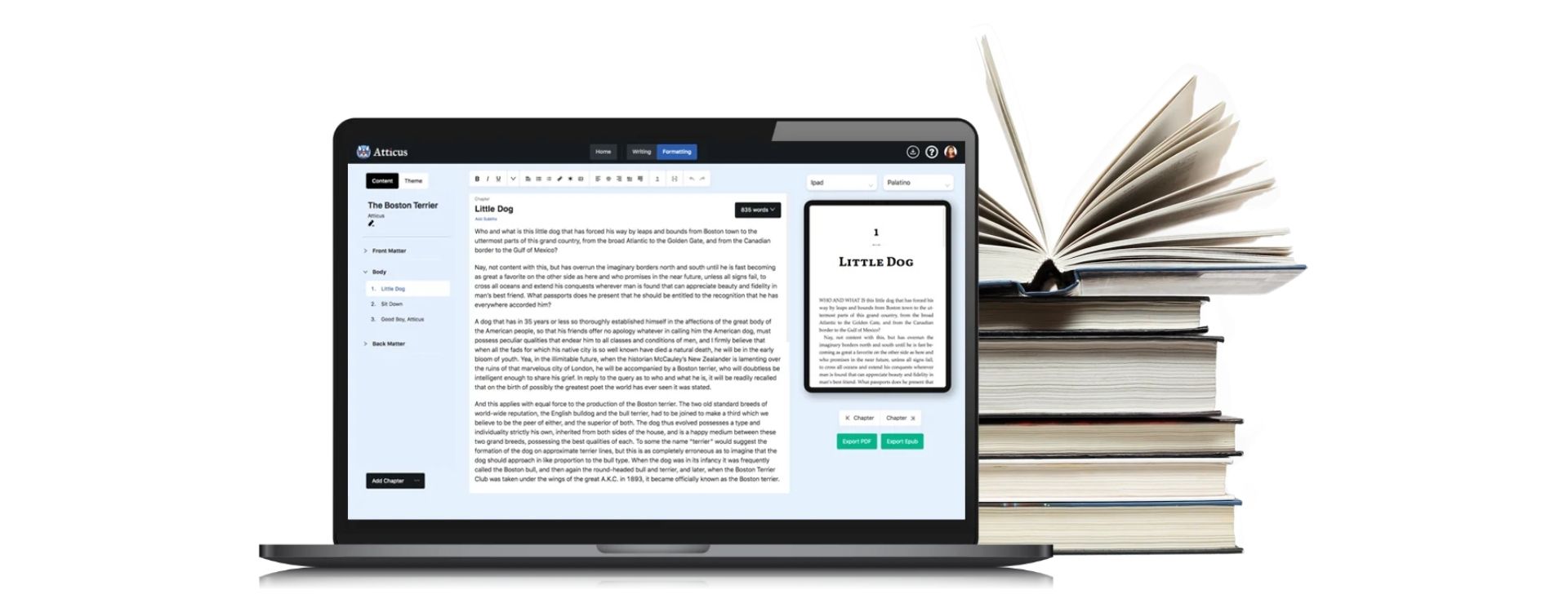
Explore Atticus, the Best Software That Writes Books, tailored for creative writers, poets, and self-published authors seeking the best writing software.
It’s easy to use and has many great features, making it a fantastic option for new and experienced writers. With Atticus, writing a book becomes a smooth, enjoyable process.
Key Features:
- Drag-and-drop editor
- Import and export functionality
- Cloud-based
Pricing: Atticus comes with a price tag of $197 per year, and unfortunately, there’s no free version available.
What I Like:
- Sleek, intuitive interface
- Flexible formatting options
- Great for collaborative writing
What I Dislike:
- No free version
- Limited customer support
Why I Recommend It:
- Offers a seamless writing experience
- Excellent for novel writing and poetry
- Enhances productivity with its easy-to-use features
Dabble
Best for: Novelists, scriptwriters, and story planners.
Are you looking for the best software that writes books? Meet Dabble, your new creative partner! Dabble is a game-changer in the best writing software category, perfect for novelists, scriptwriters, and story planners.
It’s not just a book writing app—it’s a tool that brings your stories to life. Start writing a book with Dabble, and embrace the art of storytelling like never before.
Key Features:
- Plot grid for story structuring
- Sync across all devices
- Auto-save feature
Pricing: Dabble costs $9.99 per month, but it does offer a free trial for those wanting to test the waters.
What I Like:
- Interactive plot grid
- Smooth syncing between devices
- Excellent for novel writing
What I Dislike:
- Requires internet connection
- No offline mode
Why I Recommend It:
- Simplifies story plotting
- The auto-save feature prevents loss of work
- Allows for efficient organization of ideas
Novlr

Best for: Professional and aspiring novelists.
Are you an aspiring author or a seasoned novelist searching for the best software that writes books?
Look no further than Novlr, the perfect book writing software for professional and aspiring novelists. This writing software is designed to turn your book writing dreams into reality.
Key Features:
- Focus mode to reduce distractions
- Night mode
- Chapter and novel organization
Pricing: Novlr charges $10 monthly but offers a free trial for potential users.
What I Like:
- Streamlined interface
- Powerful writing and editing tools
- Helpful focus mode
What I Dislike:
- Limited features in a free trial
- No writing templates
Why I Recommend It:
- Great for maintaining focus
- Excellent novel writing software
- Supportive online writing community
Scrivener

Best for: Long-form writers, researchers, and students.
Are you searching for the best software that writes books? Look no further than Scrivener! Renowned as one of the best writing software choices, Scrivener caters perfectly to long-form writers, researchers, and students.
Its advanced features make writing a book not just possible but also enjoyable. Whether you are a self-published author, a new author, or an experienced author, this book writing software is designed to elevate your book writing experience.
Key Features:
- Outlining and structuring tools
- Customizable corkboard for planning
- Research and reference management
Pricing: Scrivener has a one-off cost of $49 but offers a free trial to explore its capabilities.
What I Like:
- Powerful outlining tools
- Robust research management
- Flexible writing formats
What I Dislike:
- Steep learning curve
- No collaboration features
Why I Recommend It:
- Perfect for long-form writing
- Great for academic and research-heavy writing
- Offers a comprehensive writing environment
Microsoft Word
Best for: Everyone, from students to professionals.
Do you know that over 60% of writers use Microsoft Word as their primary writing software? Embark on your literary journey with Microsoft Word, arguably the best book writing software that has revolutionized how we write.
From aspiring authors saying “I want to write a book“, to professionals drafting their next bestseller, this writing software caters to everyone.
With its intuitive design and robust features, Microsoft Word simplifies the steps to writing a book, making it the best app for writing a book.
Key Features:
- Grammar and spell check tools
- Collaboration features
- Wide range of formatting options
Pricing: Microsoft Word comes free with any Office 365 subscription, starting at $6.99 monthly.
What I Like:
- Easy to use
- Excellent collaboration options
- Compatible with most devices
What I Dislike:
- Lacks advanced book writing features
- No distraction-free mode
Why I Recommend It:
- Reliable and widely used
- Great for basic book writing needs
- Offers a familiar writing environment
Google Docs
Best for: Collaborative Writing
Google Docs is a free writing software that can be used for book writing. If you’re searching for the best software that writes books, consider starting your journey with Google Docs.
It’s a familiar platform widely used by authors and writers worldwide. Its simplicity and collaborative features make it a great choice, especially for beginners and team projects.
Key Features:
- Real-time collaborative writing
- Easy sharing and commenting
- Cloud-based, making your work accessible anywhere
Pricing:
Google Docs is a free writing software offering, although additional storage on Google Drive comes with a fee.
What I Like:
- The ability to collaborate in real-time
- Flexibility and accessibility
- The auto-saving feature eliminates the fear of losing work
What I Dislike:
- Lack of more advanced formatting and layout features for book writing
- Dependency on Internet connection
Why I Recommend It
Despite its shortcomings, I highly recommend Google Docs to anyone who wants to write a book online.
It’s a straightforward, easy-to-use book writing app that doesn’t intimidate novice writers. Moreover, it’s a free writing software that handles the basics of book writing well.
Scribbler
Best for: Plot Development
Next on our list of best book writing software is Scribbler. It’s a fantastic tool specially designed for novelists. This software helps you organize your thoughts, plot your story, and keep track of your characters. It’s perfect for those who aim to craft a compelling narrative.
Key Features:
- Drag and drop chapter organization
- Character tracking
- Visual plot timeline
Pricing:
Scribbler offers a free trial. Their premium version is priced at $9.99 per month.
What I Like:
- Details-oriented features for comprehensive plot development
- User-friendly interface
- Helpful prompts to aid in story progression
What I Dislike:
- Limits on the free version
- It can be sophisticated for beginners
Why I Recommend It
I recommend Scribbler primarily for its plot development tools. It’s an excellent book writing app that goes beyond simple text editing and dives into the mechanics of crafting a novel. Use it if you want software that assists in creating a well-structured storyline.
Reedsy
Best for: Editing & Publishing
Reedsy is not just a writing program. It’s an all-in-one book writing, editing, and publishing platform. It’s best for authors who want a seamless transition from writing to publishing.
Key Features:
- In-built professional typesetting
- Online marketplace of professional editors and designers
- Export options perfect for self-publishing
Pricing:
Reedsy is free to use for writing and formatting. Charges apply when you opt for their marketplace services.
What I Like:
- Professional typesetting and formatting that make the book ready for publishing
- Seamless transition from writing to publishing
- High-quality export options
What I Dislike:
- Limited writing and editing features
- Marketplace services can be expensive
Why I Recommend It
Reedsy is a strong contender among the best book writing software because of its integrated approach to writing and publishing.
I recommend it for authors who want to streamline their book creation process, from the first draft to the final published book.
yWriter
Best for: Organized drafters and outline enthusiasts.
yWriter is a software that writes books with a focus on organization. An author created it so it understands the intricacies of writing a book. This software breaks down your novel into scenes and chapters, making it easier to manage a complex storyline.
Key Features:
- Scene and chapter organization
- Character and location tracking
- Word count tracker and goal setting
Pricing:
yWriter is free writing software, but donations are welcome. It’s a great book writing software free of charge.
What I like:
- Intuitive design
- Highly customizable
- Focus on structure
What I dislike:
- No mobile app
- Limited formatting options
Why I recommend it:
yWriter offers an organized approach to book writing. If you’re an author who loves outlining, this could be your best writing software. It’s free, intuitive, and designed with an author’s perspective.
DO YOU KNOW: Typing speed can increase by 33% using speech recognition software?
Bibisco
Best for: Character-driven storytellers and plot architects.
Bibisco is an open-source novel writing software that gives you a special focus on characters. This could be your best app for writing a book if your stories are driven by character development and intricate plots.
Key Features:
- Character development tools
- Timeline tracking
- Scene sequencing
Pricing:
Bibisco offers a free software version, with a premium version available for additional features. It’s free writing software with a paid upgrade.
What I like:
- Character-centric tools
- Open source
- Export to PDF and Word
What I Dislike:
- The interface can be clunky
- Limited formatting options
Why I recommend it:
Bibisco is a powerful tool if you want to write a character-driven book. The software is optimized to help authors delve into their characters and plots more effectively.
Vellum
Best for: Polished eBook formatting
Key Features:
- High-quality eBook and print formatting
- Easy-to-use interface
- Preview feature to visualize the final product
Pricing:
Vellum pricing starts at $199.99. There’s no free version, only a free demonstration.
What I Like:
- Simplicity of use
- High-quality output
- Great customer service
What I Dislike:
- Only available for Mac users
- The cost could be high for some
Why I Recommend It:
If you’re seeking a professional touch in your eBook layout, Vellum is the best software that writes books.
Its user-friendly interface, along with its high-quality output, makes it a popular choice among authors.
However, its availability is only for Mac users, and the high cost may deter some writers.
ProWritingAid
Best for: Comprehensive Grammar checking
Key Features:
- In-depth writing reports
- Grammar and style suggestions
- Integrates with multiple platforms
Pricing:
ProWritingAid offers a free version with limited features; premium versions start at $79 per year.
What I Like:
- Detailed reports
- Useful for improving writing style
- Good value for money
What I Dislike:
- It can be overwhelming for new users
- It doesn’t work offline
Why I Recommend It:
ProWritingAid is more than a grammar checker. It’s a comprehensive tool that helps improve your writing style, making it among the best writing software available.
Its detailed reports are beneficial, although they can overwhelm new users. The inability to work offline might be a downside for some.
Publisher Rocket
Best for: Book Marketing
Key Features:
- Keyword search
- Competition analyzer
- AMS Keyword feature
Pricing:
Publisher Rocket costs a one-time fee of $97. There’s no free version.
What I Like:
- Helpful for increasing book sales
- Easy to use
- Great customer service
What I Dislike:
- Data can sometimes be inaccurate
- No free trial
Why I Recommend It:
If you aim to boost your book sales, Publisher Rocket is the best book writing software for marketing.
Its keyword search and competition analyzer features provide valuable insights for authors. However, occasional inaccuracies in data and the lack of a free trial may disappoint some.
Evernote
Best for: Note-Taking and Organization
Evernote is a writing app that can be used for note-taking and organizing ideas. With its ability to sync across multiple devices, it is considered one of the best apps for writers who are always on the go.
It’s also a practical choice for those thinking, “I want to write a book” but need a flexible platform to jot down spontaneous ideas.
Key Features:
- Cross-platform accessibility
- Web clipper feature
- Document scanning
Pricing:
Evernote offers a free version. Premium versions start at $7.99 per month.
What I Like:
- Great for organizing notes
- Accessible from anywhere
- The web clipper is handy
What I Dislike:
- The free version has limitations
- The premium version may come across as pricey for some
Why I Recommend It:
Evernote is a great tool for note-taking and organizing — essential steps to writing a book. Its cross-platform accessibility means you can jot down ideas anytime, anywhere.
The free version of Evernote has its limitations, though, and the cost of the premium version might be a turn-off for some authors.
The Pros and Cons of Free Book Writing Software
Software that writes books has become a valuable tool for authors. From the seasoned novelist to the aspiring writer exploring the idea of “I want to write a book,” the right writing program can make the process smoother.
While premium options often provide a wide range of features, free book writing software has its own advantages and drawbacks worth considering.
Remember: The best writing software fits your writing style and needs.
Pros of Free Book Writing Software:
- Easy on the pockets: Ideal for beginners and those on a budget.
- Test run: Allows you to explore different writing apps and programs without financial commitment.
- Basic functionalities: The freest software offers fundamental features sufficient for writing a book.
Cons of Free Book Writing Software:
- Limited features: Advanced features like detailed plotting assistance, character development tools, and in-depth editing may be lacking.
- Ads: Free software often comes with pop-up ads, which can be distracting.
- Less user support: The free version usually needs more customer service.
Choosing the right book writing software involves considering your needs, budget, and writing style. Here are some steps to guide you:
- Identify your needs: What features are most important to you? Are you looking for an app to write a book or a more comprehensive novel writing software?
- Try before you buy: Use free trials or the basic version of different writing software. Do you like the interface? Is it user-friendly?
- Read reviews: Reviews from other writers can provide valuable insights.
- Consider your budget: If you’re prepared to invest, premium software often provides more advanced features.
In the end, whether you choose a free writing program or a premium one, the best book writing software is the one that helps you write more effectively and enjoyably.
Tips for Using Book Writing Software Effectively
Choosing the best software that writes books can make your authorial journey less daunting and more efficient.
But, maximizing the potential of your book writing software goes beyond just downloading and using it. Here are five handy tips for using your software effectively:
- Understand the Features: Whether it’s a book writing app or desktop software, it’s essential to familiarize yourself with its features. This includes writing programs, editing tools, organization features, and more. The best writing software often has a steep learning curve, but it’s worth the investment.
- Regular Updates: The best book writing software often comes with regular updates. These updates usually include new features, bug fixes, and improvements. Ensure to update your software regularly to enjoy these benefits.
- Customize to Suit Your Needs: The best software that writes books offers customization options. You can adjust the writing environment, font sizes, and styles, among other things, to suit your writing preferences.
- Take Advantage of Free Writing Software: If you’re on a budget or just starting your writing journey, consider free writing or book writing software free tools. They often offer basic features to help you start writing a book.
Backup Regularly: Don’t risk losing your work. Ensure to make regular backups of your work. Some writing apps and software come with automatic backup features. Use them!
FAQ: The Best Software That Writes Books
What software do most authors use?
Most authors today rely on advanced book writing software to pen their novels. Scrivener and Microsoft Word are among the best writing software many writers use.
They offer a seamless writing experience and aid authors in organizing their work efficiently.
What software does JK Rowling use?
JK Rowling, one of the world’s most successful authors, initially wrote the Harry Potter series by hand and later transferred them to a word processor.
For planning her plots, she is known to use a simple pen-and-paper grid method. However, it’s worth noting that every writer has their process and may prefer different writing apps.
What platform do authors use to write?
Authors use a variety of platforms for writing a book. Microsoft Word remains a staple due to its simplicity and wide use.
However, software like Scrivener, Google Docs, and Final Draft have become popular among authors for their specialized features tailored to the novel writing process.
What is the best platform to write a novel?
The best platform for novel writing largely depends on the author’s needs. Scrivener is a novel writing software many love for its extensive features designed specifically for writers.
Another great option is yWriter, a free book writing software that helps break down your novel into chapters and scenes.
What software does Stephen King write on?
In his memoir “On Writing,” Stephen King mentioned that he uses Microsoft Word. This shows that even the best books on writing can be crafted with the most simple and readily available tools. However, the choice of software ultimately comes down to the individual writer’s preference and comfort.
What software do famous novelists use?
Famous novelists use various software, from the traditional Microsoft Word to more specialized tools like Scrivener and Final Draft. Some authors also use book writing apps like Evernote to jot down ideas and snippets. It’s all about finding what works best for their creative process.
Do famous authors use Scrivener?
Yes, several famous authors have been open about their use of Scrivener. Its ability to organize chapters, research, and notes in one place makes it an excellent choice for many writers. But remember, every author has a unique process, and the best app for writing a book is the one that fits seamlessly into that process.
Do professional authors use Scrivener?
Many professional authors prefer using Scrivener for its comprehensive features and flexibility. It offers a versatile platform suited to the varied needs of authors, making it one of the best apps for writers.
What does Stephen King use to write his books?
As mentioned earlier, Stephen King uses Microsoft Word to write his books. The simplicity and familiarity of Word make it a go-to choice for many professional authors.
What is the best platform for new writers?
New writers may find platforms like yWriter and Scrivener helpful as they start their writing journey. These programs offer great features for writing a book, such as character development tools, plot tracking, and more.
New writers can also use online platforms to write a book online and get instant feedback from readers.
Do most writers use a computer?
Yes, most writers nowadays use a computer for their writing process. Writing software and book writing apps have become common practices, offering efficiency and convenience in organizing and editing work.
Do authors use Microsoft Word?
Many authors, including famous ones like Stephen King, use Microsoft Word. Its simplicity, wide acceptance, and familiar interface make it one of the most used writing programs by authors worldwide.

Wrapping Up On The Best Software That Writes Books
Choosing the best software that writes books can feel like an epic quest. But it’s not a dragon you need to slay, but a challenge to conquer. Remember how Frodo felt when he first set out from the Shire? That’s you, embarking on your book writing adventure.
Whether you’re a newbie dreaming of writing a book, or a seasoned author searching for the best writing software, the tools you need are within your grasp.
Imagine if J.K. Rowling had access to a book writing app while creating the Harry Potter universe. Would she have finished writing sooner?
Having the right software can certainly streamline the process.
There’s a wealth of book writing software free of charge, while others are worth every penny.
So, whether you prefer free writing software like Google Docs or specialized novel writing software like Scrivener, remember that the best tool is the one that fits your unique writing style.
Mark Twain once said, “The secret of getting ahead is getting started.” It’s time to pick your software, start your journey, and write that book.